
Golfing News & Blog Articles
Blended Golf Iron Sets Explained (Who Should Play Them And How to Build Yours)

When most amateurs buy irons, they pick a model they like and order the complete set.
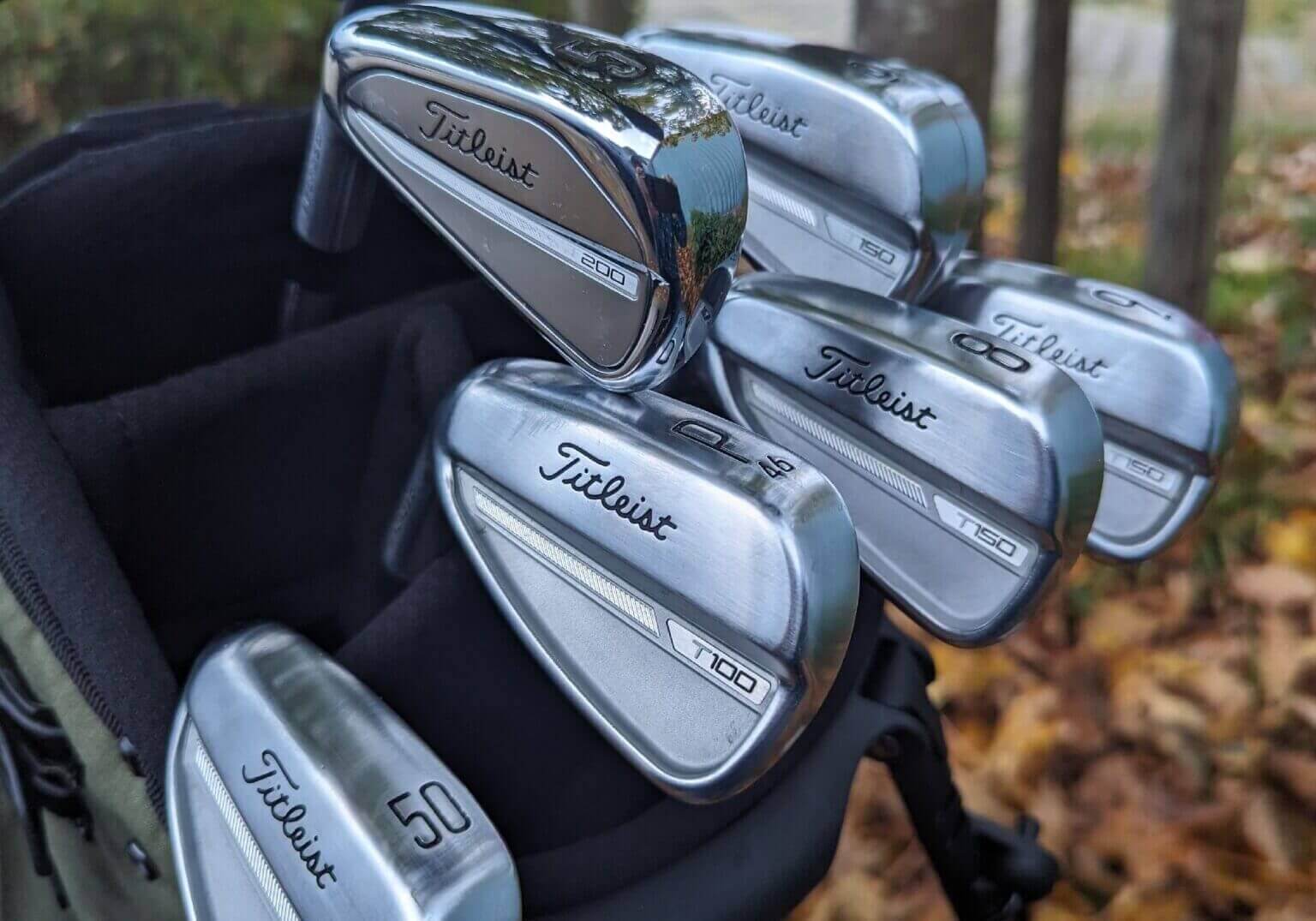
But if you look in better players’ bags, especially the pros’, that’s not what’s happening anymore. Titleist’s own fitters say roughly 80 percent of their tour staff now play blended sets, often with three different iron models in one bag.
I’m in that camp, too. I didn’t love my 5-iron. In my latest fitting, we dropped a more forgiving Titleist T350 in that spot and kept a more compact player’s distance head in the rest of the set. If you’ve thought about a blended iron set but need some direction, you’re in the right place.
What a blended iron set really is
A blended (or combo) iron set is simply:
Two or more iron models in one set, each chosen for a specific job.
For many golfers, the long irons (3-5 or 4-6) are more forgiving, launch higher and have faster hollow-body heads. They’re followed by the short irons (7-PW/GW) in a more compact clubhead built for control, spin consistency and predictable yardage.
The goal of the blended iron set is to make sure there are no drops in ball speed across the bag. In addition, fitters consider factors such as peak height and descent angle to ensure the ball can be stopped on the green.
Brands that are designed to blend
Some brands are better at creating sets that blend than others. You have to watch things like loft, design and shaping to make sure you don’t feel like you’ve got 14 disparate golf clubs in the bag. Here are a few examples of brands/iron series that do well with blending. Srixon even has a combo set builder on their website.
| Manufacturer | Iron families designed to blend |
|---|---|
| Titleist | T-Series (T100, T150, T250, T350) + utilities like U•505/T-Series |
| Srixon | ZX / ZXi / Z-Forged families |
| Mizuno | Mizuno Pro (241/243/245) |
| TaylorMade | P-Series (P7MB, P7MC, P770, P790) |
| Callaway | Apex Pro family (Apex Pro, Apex CB, Apex MB) |
| COBRA | KING CB/MB “Flow Set” |
If you stay inside these families, the topline, offset, loft structure and center of gravity are already designed to transition cleanly from “helpful” long irons to “precise” short irons. That’s why you’ll see fitters gravitate to them for combo builds.
Why you can’t just mix anything and call it “blended”
There are three big traps that amateur golfers should be aware of when blending iron sets.
1. Loft and distance don’t line up
When you blend distance-style long irons with more traditional short irons, you can’t assume the yardages will fall into place just because the loft numbers look close. Distance heads are usually stronger lofted, faster off the face and spin less so it’s very easy to end up with either two clubs that go almost the same distance or a huge gap where one should be. You can fix it by bending lofts to tighten the carry gaps but that always needs to be checked and tuned.
2. Too much tech in the wrong end of the set
Blended sets work best when you use the extra tech where you actually need help. For most players, this is in the long and mid irons. Heads with more tech (wider soles, more tungsten, hotter faces) launch higher and add ball speed but in short irons, that can start to hurt control instead of helping it.
That’s why better players usually:
Use more tech and lower CG in the long irons for launch and forgiveness Use less tech and a higher CG in the short irons for consistent spin, tighter yardages and a more solid, predictable feel3. Head weight, hosel depth and feel
Blending iron models gets a little techy behind the scenes because things like head weight and hosel depth can change how the shaft plays and how the club feels, even when the specs on paper look the same.
Different heads may not follow the same weight progression and small changes in how deep the shaft sits in the hosel or how high it sits off the ground can subtly affect flex, balance and delivery. You don’t need to solve that puzzle yourself. That’s exactly why a blended set is something you should dial in with a fitter.
How to know where to “break” your set
Instead of picking an arbitrary club (as in “I’ll just break it at the 5-iron”), you can use a couple of simple checkpoints to tell you exactly where the current head design stops doing its job and a different model should take over.
1. Ball speed gap
Instead of chasing a specific number, pay attention to where your ball speed stops climbing as you move into the longer irons. If your 7-iron, 6-iron and 5-iron all show healthy jumps in ball speed and distance but your 4-iron barely gains anything (or even drops), that’s your sign the head design has stopped helping you. That’s the point where a different model, a more forgiving long iron, utility iron, hybrid or higher-lofted fairway wood will usually do a better job than just another iron from the same set.
2. Peak height window
Peak height is one of the easiest ways to tell where your current iron head stops doing its job. Use one trusted iron (usually your 7-iron) as your “height window” and then see which longer iron can no longer reach that window consistently.
You can keep it this simple.
Step 1: Set your baseline. Note how high your 7-iron flies when you hit it solid (on a monitor or just visually). That’s your peak-height window. Step 2: Test your longer irons. Hit 6-iron, then 5-iron, and watch for the first club that flies noticeably lower or shows a much wider spread in height. Step 3: That’s your break point. The first iron that can’t perform in that same peak-height window or range is the one that should probably be switched for a more forgiving iron.
Signs a blended iron set could be right for you
A blended set isn’t just for golfers who hate long irons. It’s for anyone who feels like some irons don’t quite match what they need.
A blended iron set may help if:
Your long irons fly too low, don’t stop on greens or only work when you absolutely flush them. Your short irons feel too hot or bulky and you can’t easily flight or shape shots. Your distances don’t make sense. One iron barely goes farther than the last or there’s a big jump where a single club suddenly goes way too far. You have clear “trust clubs” and “hope clubs.”Final thought
The main idea behind blended sets is simple: stop forcing one iron model to do everything for you.
Tour players have already figured out that different parts of the set ask for different things: more tech and forgiveness up top, more control and consistency down low. Use ball speed and peak height to determine where your set should break and stay in families designed to blend.
The post Blended Golf Iron Sets Explained (Who Should Play Them And How to Build Yours) appeared first on MyGolfSpy.

